
Supporting museums and non-profit institutions in the Pacific Northwest
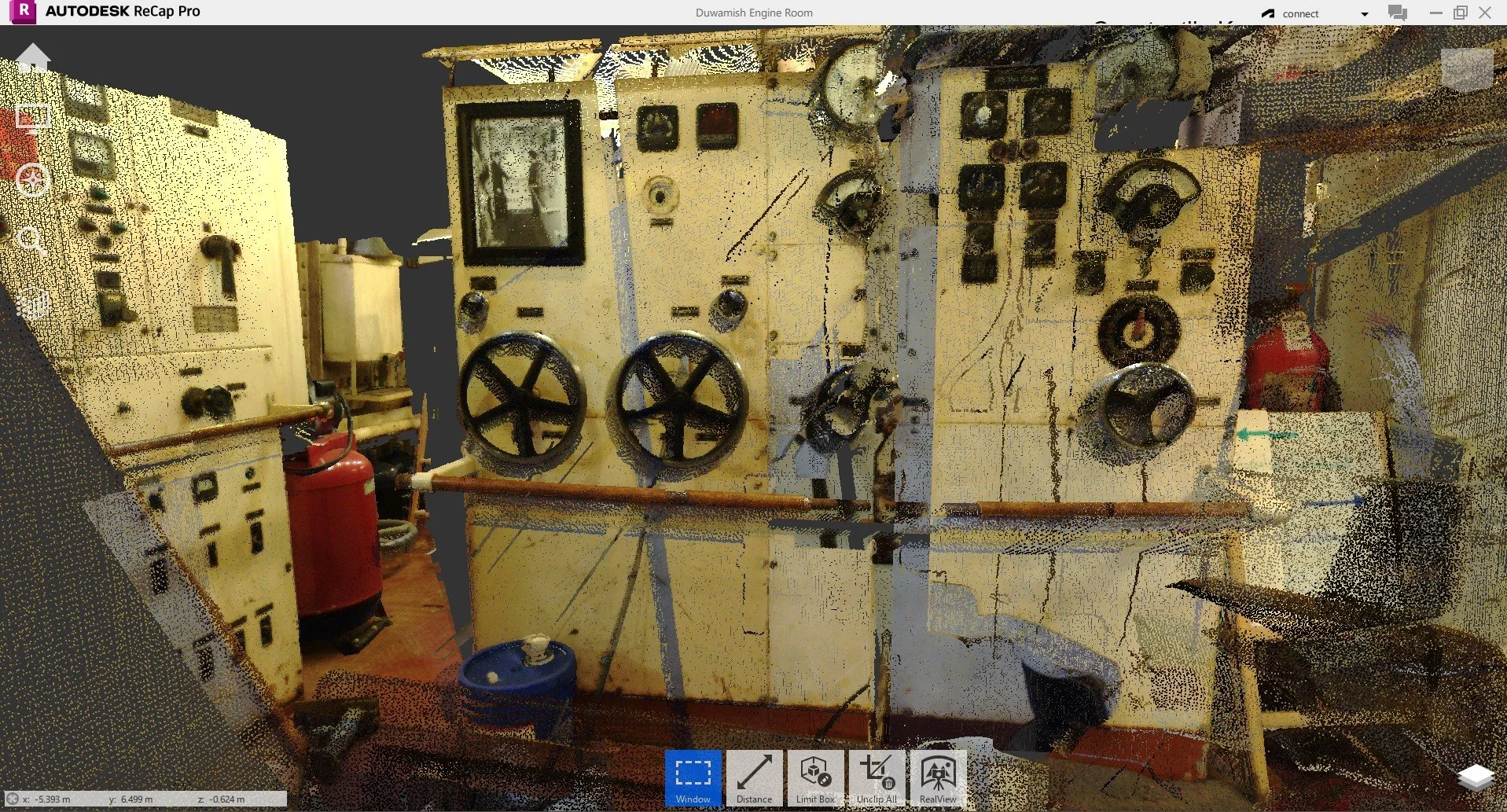
Fireboat Duwamish engine room
Using Digital Technology to Preserve, Document, and Share Our Heritage
Ilios Remote Sensing works with museums, historic vessels, cultural institutions, and nonprofit organizations to digitally document important places, objects, and collections while helping make them accessible to a wider audience.
Working with the Hellenic Archaeological Exploration Society, we provide technical expertise and reality-capture services using terrestrial laser scanning, photogrammetry, and interactive virtual tours.
These technologies can serve very different purposes—from creating a highly accurate three-dimensional record of a historic vessel to allowing someone on the other side of the world to virtually explore a museum.
Our objective is simple:
Use technology to help preserve the past, support the organizations protecting it today, and make it accessible to future generations.
Digital Preservation
Capture It Today. Preserve a Record for Tomorrow.
Historic structures, vessels, machinery, and artifacts inevitably change with time.
Terrestrial laser scanning provides a way to create a highly detailed three-dimensional record of an object or environment as it exists today.
Millions of spatial measurements are captured to create a dense 3D point cloud that preserves geometry, dimensions, and spatial relationships. That digital record can later support preservation, restoration, research, documentation, visualization, or comparison as the subject changes over time.
For historic vessels and structures in particular, this provides something photographs and traditional drawings cannot—a comprehensive, measurable three-dimensional record.
Preserving the Fireboat Duwamish
High-Resolution Documentation of a National Historic Landmark
The historic Fireboat Duwamish is one example of how terrestrial laser scanning can support preservation.
Ilios Remote Sensing is working to digitally document the vessel using high-resolution terrestrial laser scanning, creating a detailed three-dimensional record that can help preserve information about the ship and its machinery for future generations.
The engine room illustrates the particular value of this technology. Dense machinery, piping, equipment, structural components, and confined spaces make conventional documentation difficult.
Laser scanning captures these complex relationships in three dimensions.
The resulting dataset preserves not simply what the machinery looks like, but where it is and how the components relate to one another. The flythrough at the top of this page helps provide a video like tour of the scan data.
Virtual Access & Public Outreach
Bring the Museum to People Who Cannot Come to the Museum
Physical access will always be important, but geography, mobility, accessibility limitations, operating hours, and other barriers prevent many people from visiting museums and historic sites.
Interactive virtual tours provide another form of access.
Visitors can move naturally through a museum, historic building, or vessel; understand how spaces connect; examine areas of interest; and return whenever they choose.
For museums and nonprofit organizations, this creates an opportunity to reach schools, researchers, prospective visitors, donors, members, and the general public far beyond the organization's physical location.
A museum's potential audience should not be limited by its front door. Explore the Foss Seaport Waterway Museum in Tacoma, WA below.
Turn the Tour Into an Interpretive Experience
Let Visitors Explore, Discover, and Learn
Tags are particularly powerful for museums, historic sites, and nonprofit organizations because they can turn a virtual walkthrough into something closer to a self-guided digital exhibit.
Tags can identify artifacts and exhibits, provide historical context, display historic photographs, explain machinery or equipment, highlight architectural features, describe preservation and restoration work, introduce programs and services, link to videos and other media, and direct visitors to additional educational resources.
For nonprofit organizations, tags can also explain how facilities are used, highlight projects, communicate the organization's mission, and demonstrate the impact of its work.
The result is more than remote access.
It becomes an interactive tool for education, interpretation, outreach, and public engagement.
Turn a Virtual Tour Into an Educational Experience
Tags Add the Story to the Space
An interactive tour allows visitors to explore. Tags allow museums and nonprofits to explain what visitors are seeing.
Interactive tags can be placed directly within the virtual environment at the location of an artifact, exhibit, machine, room, or other point of interest.
Tags can:
Identify artifacts and exhibits
Provide historical context
Explain machinery and equipment
Display archival photographs
Describe restoration or preservation work
Introduce people associated with an object or place
Link to videos and additional media
Direct visitors to educational resources
Explain the significance of a particular room or feature
Provide information that may not fit on a physical exhibit label
Instead of separating the information from the object, the information appears where it is relevant.
This can transform a virtual tour into something much closer to a self-guided digital exhibit.
United States Coast Guard Museum Northwest
See Interactive Interpretation in Action
The United States Coast Guard Museum Northwest demonstrates how an interactive tour can combine remote access with educational interpretation.
Visitors can explore the museum virtually while interactive tags provide additional information about exhibits and objects encountered throughout the space.
Look for the blue interactive tags throughout the tour.
On a computer, hover over or select a tag. On a mobile device, tap it to display additional information. This type of interpretation can be expanded as a museum's needs evolve, allowing the virtual experience to become an additional platform for education and outreach.
Historic Ships
Provide Access to Spaces Many Visitors Cannot Reach
Historic vessels present particular challenges for public access.
Steep ladders, narrow passageways, machinery spaces, accessibility limitations, preservation concerns, geographic location, and limited opening hours can prevent many people from experiencing an entire ship. The engine room of the Fireboat Duwamish is one example.
Interactive tours provide another way to explore these vessels while preserving the relationship between their different spaces.
Visitors can move from compartment to compartment and understand how the vessel fits together in a way that collections of individual photographs cannot communicate.
Tags can add historical photographs, machinery descriptions, crew stories, engineering information, restoration details, and other interpretation directly within the vessel.
Northwest Seaport Maritime Heritage Center
Bringing Historic Vessels to a Wider Audience
Ilios Remote Sensing is grateful to work with the Northwest Seaport Maritime Heritage Center in support of its mission to preserve and share the maritime heritage of the Pacific Northwest.
Interactive tours of historic vessels allow people to explore these ships remotely while helping introduce a wider audience to the vessels, their history, and the organizations working to preserve them.
Historic Tugboat Arthur Foss
The Arthur Foss provides an excellent example of how a virtual tour can make the complex interior of a historic vessel accessible online.
F/V Tordenskjold
The historic fishing vessel Tordenskjold provides another opportunity to explore the working spaces of a preserved vessel and better understand the maritime heritage of the Pacific Northwest.
Supporting the Future of Maritime
YTB Propeller
Preserving maritime heritage is not only about documenting historic vessels. It is also about helping organizations introduce future generations to maritime careers, technology, and the people who keep the maritime industry operating.
Our interactive work with YTB Propeller demonstrates how the same technology can support education, workforce outreach, and nonprofit engagement.
Digital Artifact Preservation
Bring Individual Objects Into the Digital World
Not every preservation project involves an entire building or vessel.
Photogrammetry can be used to create detailed three-dimensional models of individual historic objects and artifacts.
A series of overlapping photographs is processed to reconstruct the visible geometry and appearance of the object, creating a digital model that can be examined from different directions on a computer, tablet, or phone.
These models can support documentation, research, education, online exhibits, interpretation, and public outreach while reducing the need to physically handle fragile objects.
The artifact remains safely in the collection while its digital counterpart can travel anywhere.
Historic Artifacts in 3D
With the cooperation of the institutions like the United States Coast Guard Museum Northwest and Fireboat Duwamish, Ilios Remote Sensing has created photogrammetric models of historic artifacts in their respective collections. These projects demonstrate how relatively small objects can become interactive digital exhibits that can be viewed and explored online.
US Coast Guard Museum NW
Manby Mortar
The Manby Mortar was an early 19th-century maritime rescue device designed to fire a line from shore to a vessel in distress.
Fireboat Duwamish
Lamp
A three-dimensional model allows visitors to examine this historic piece of maritime equipment independently from the vessel on which it served.
Water/Oil Filter
This model preserves and presents another piece of the vessel's engineering history, allowing the object to be examined interactively from virtually anywhere.
Historic Buildings & Sites
Document the Place as Well as the Objects
The same technologies can be applied at the scale of an entire historic building or site.
Interactive virtual tours provide public access and interpretation, while measured documentation can create a record useful to the organizations responsible for maintaining and preserving the property.
The Manchester Torpedo Warehouse at Manchester State Park demonstrates how one digital capture can support public engagement while also producing useful building documentation. A case study can be found here.
More Than One Technology
The Right Tool Depends on What Needs to Be Preserved
Museums and nonprofit organizations have very different needs, which is why Ilios Remote Sensing works with multiple forms of reality-capture technology.
Terrestrial Laser Scanning
Creates highly detailed, measurable three-dimensional records of structures, vessels, machinery, and complex environments.
Interactive Virtual Tours
Allow people to remotely explore museums, vessels, historic buildings, and other spaces while supporting education and public outreach.
Interactive Tags
Add interpretation directly inside a virtual environment, connecting information and stories with the places and objects to which they relate.
Photogrammetry
Creates detailed 3D models of artifacts and objects that can be documented, studied, shared, and incorporated into digital exhibits.
These technologies can be used independently or together depending on the goals of the organization.
The technology is the tool. Preservation, access, education, and outreach are the objectives.
Supporting Organizations That Preserve Our Heritage
Ilios Remote Sensing believes advanced reality-capture technology should not be limited to organizations with large commercial budgets.
Through our collaboration with the Hellenic Archaeological Exploration Society and other nonprofit partners, we seek opportunities to contribute technology, expertise, equipment, and services to projects that support preservation, archaeology, education, research, and public access.
Our work with museums, historic vessels, and cultural organizations in the Pacific Northwest represents part of that commitment.
We are particularly interested in projects where digital documentation can help preserve something that may otherwise be lost, make an inaccessible place available to a wider audience, or help an organization tell its story in a new way.
Have Something Worth Preserving?
Tell Us About It.
If your museum, nonprofit organization, historic vessel, cultural institution, or preservation project could benefit from laser scanning, photogrammetry, interactive virtual tours, or digital documentation, we would like to hear about it.
Not every project requires the same technology, and not every worthwhile preservation project has a large budget.
Tell us what you are trying to preserve, document, or share. We can discuss what technology—and what level of support—makes sense for the project.